
Twelve Steps for Twelve Months
Step 8: Naming the Harmed
By Steve Gutierrez-Kovner, Illuman SoCal, Poet
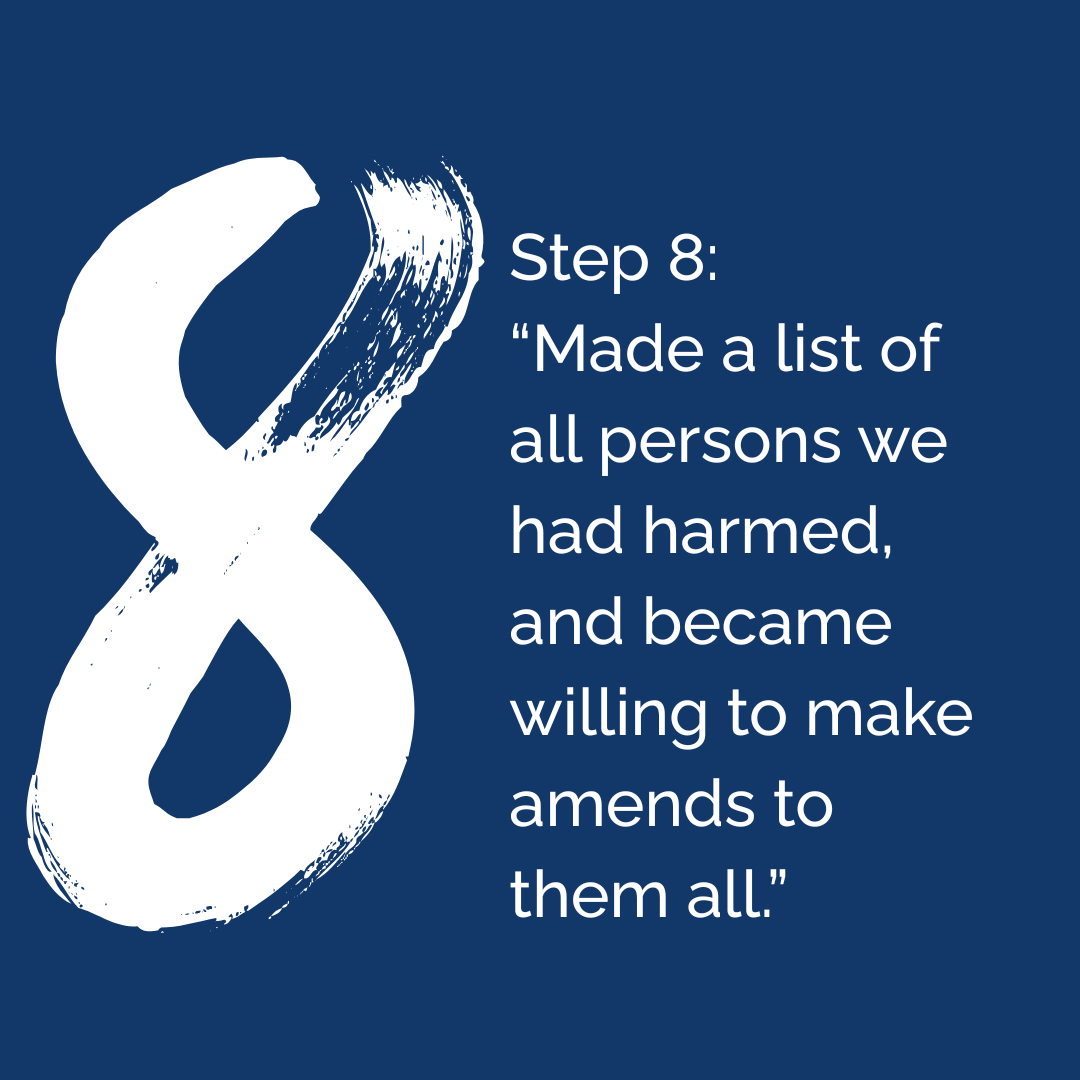
Step 8 moves us further into action by concretizing – in writing drawn from our 4th Step inventory – some of the harms to specific persons in our life that we have caused with our addiction(s) … as always, whether named or the more general human addiction to control. As Bill Wilson writes in the Twelve and Twelve: “[We] can make little headway in this new adventure of living until [we] first backtrack and really make an accurate and unsparing survey of the human wreckage [we have] left in [our] wake.” (p77)
So, as we’ve likely already identified the persons we’ve hurt, how should we then define “harm”? Wilson frames it as “the result of instincts in collision, which cause physical, mental, emotional or spiritual damage to people.” (12&12, p80), while Ramy Shapiro suggests it “is to deliberately mislead another for one’s own gain or benefit.” (Recovery–The Sacred Art, p111). But perhaps Richard Rohr puts it most succinctly as part of his praise of 12 Step programs … “the only group I know that is willing and honest enough to just tell people up front, ‘You are damn selfish!’.” (Breathing Underwater, p71)
This selfishness – whether manifesting as instincts in collision or deliberate deceit – is typically a survival mechanism born of fear and pain; fear of rejection and pain when rejected: “afraid that if we are truly ourselves no one will like us, so we create a false image of ourselves that others will like.” (Recovery, p112). AKA the False Self we construct around our True Self, to protect ourselves, as we brothers in Illuman became intimately familiar with in our MROPs. But this False Self turns us, in addiction, toward “self-destructive self-medicating behavior in order to dull the fear and ease the ache of rejection.” (Recovery, p113)
Therefore, before we begin in Step 9 to start making amends to others, perhaps we first need to consider apologizing to ourself, our True Self. As Wilson suggests, having made “an accurate and really exhaustive survey of our past life as it has affected other people. In many instances we shall find that though the harm done others has not been great*, the emotional harm we have done ourselves has.” (12&12, p79) And acknowledging this self-harm can be a long process. “We slowly learn to love the person we actually are: the broken person, the ordinary person, the wounded person. We no longer use our wound as a crutch or a club, but rather as a reminder of our ordinariness, which in turn softens our heart and allows us to embrace the equally imperfect people around us.” (Recovery, p115)
As Richard reminds us: “You learn to salve the wounds of others by knowing and remembering how much it hurts to hurt.” (BU, p69) And while Rohr wisely states that “it might take a long time to become willing to make amends” (BU, p73), Wilson encourages us forward: “Whenever our pencil falters, we can fortify and cheer ourselves by remembering what [12 Step] experience in this Step has meant to others. It is the beginning of the end of isolation from our fellows and from God.” (12&12, p82)
Next month, we begin the end to isolation by bravely stepping into our amends to our fellows!
*My wife, in reading this, begs to differ. More often, she would argue (and I would wholeheartedly agree), our “harm done others” was very, very great. Yet, the point, I feel, still holds: the emotional, psychological and spiritual damage to the addict’s own soul as well, is often incalculable, and, more often, unacknowledged … yet needs to be, in the recovery process.